How crossbreeding strategy is improving resilience at California dairy

In California’s Central Valley, where water scarcity, market volatility, and political uncertainty loom large, one family is proving that adaptability is the key to resilience.

The Hoekstra family have been at the forefront of crossbreeding in the USA and believes it has been key to improving resilience by breeding a more robust animal. Kurt milks 3,500 cows across two sites in Oakdale, California, alongside his son Tanner, brother Jack, and Jack’s son, Willem.

Just 10 miles apart from each other, they milk 1,200 crossbreds at their homestead Hoekstra Dairy, while Cross View is the larger of the two, milking 2,200 crossbred cows. They took over Cross View Dairy in December 2013 on a 15-year lease. They pay $216/cubicle annually for 2,000 cubicles ($432,000).

A legacy of crossbreeding

Kurt’s father, Bill, began crossbreeding more than 25 years ago. Prior to this, they had pure Holsteins. 

“We started with Holstein and Jersey and liked the Hojo cross, but we felt we needed one more breed because we were getting too much size differential,” explains Kurt. After experimenting with Normande genetics but finding udder quality was poor, they switched to ProCROSS in 2000.

ProCROSS is a three-way cross of Holstein, Coopex Montbéliarde and VikingRed genetics used in rotation.

The Hoekstras started by introducing Coopex Montbéliarde, then bred those daughters to VikingRed to improve health traits and reduce cow size. “The cows are lasting longer, are more fertile, and hold condition better. It’s all the little benefits that add up,” adds Kurt. He adds: “We now have cows in their eighth and ninth lactations – before crossbreeding, we rarely had any cows make it to their sixth.”


Hoekstra Dairy ProCROSS

Reproduction strategy and herd management

They use the top 5-10% of bulls in each breed and focus heavily on milk, fat, protein, fertility and longevity.

Sexed semen is used exclusively for the first two services. If cows return to heat after this one straw of conventional semen is used before they switch to Aberdeen-Angus genetics.

Conception to sexed semen is averaging 40%. Cows that don’t exhibit a natural heat within 55 days of calving are enrolled in a double Ovsynch programme. The herd averages 1.2 services per conception and a replacement rate of 27%.

The farm is divided into eight groups, each comprising approximately 210-230 cows, including a fresh-cow and heifer group. Cows in early lactation are housed in compost-bedded cubicles, while later-lactation animals move to open corrals bedded with maize stalks. 

Animals less than 130 days in milk are milked three times daily through a 30/30 GEA rapid exit parlour – the rest drop to twice-daily milking once they are confirmed pregnant.  

Yields are averaging 10.3 gallons daily at 3.9% butterfat and 3.45% protein, with milk supplied to Hilmar Cheese. Cows calve year-round, and the herd’s calving interval is 392 days, with days in milk currently sitting at 157. 

Fans and water-soaking systems (triggered once temperatures reach  73°F) keep cows cool. A flood-wash system that uses recycled wash water is used to keep alleyways clean. 

Feeding is tailored to the lactation stage, with six different rations formulated. Maize silage is the dominant ingredient, supplemented by alfalfa, cottonseed, canola, rapeseed and byproducts. “Feed accounts for 50% of our costs,” Kurt notes. “We grow 100% of our own wheat silage and half our corn, but the rest we purchase.”

ProCROSS cows milking Hoekstra Dairy
The cows are lasting longer, are more fertile, and hold condition better. It’s all the little benefits that add up. We now have cows in their eighth and ninth lactations – before crossbreeding, we rarely had any cows make it to their sixth.

Kurt Hoekstra,
3,500 ProCROSS cows, California, USA

Diversification and challenges

Like many other dairy farms in California, the Hoekstras diversified into growing almonds 11 years ago to offset the volatility in milk markets. This strategy helps balance losses during periods of low milk price returns. Currently, margins have been favourable, helped by milk prices of $17/cwt and lower feed prices, with canola trading for $220/t and maize $55/t.

However, water availability in the State remains a looming threat. The Sierra Nevada mountains are a crucial water source in the region, with snowmelt replenishing dams in the Sacramento Valley. However, State governors want water transported to LA, where the population density is greater.

The Hoekstras’ home dairy benefits from being within the Oakdale Irrigation District, which gives them access to groundwater and canal systems fed by dams filled by the snowmelt. Cross View Dairy, however, lies outside the district and faces a higher risk.

“We are putting in ponds to collect rainwater. We can also get water credits for saving that water, and that would allow us to offset the credits and pump at Cross View,” explains Kurt.

ProCROSS cows at the feeding table Hoekstra Dairy

Navigating uncertainty while building a stronger future

Across both dairy farms and their 405-hectare cropping enterprise, the Hoekstras employ 33 people, mostly Hispanic workers. While immigration raids have caused concern in the farming community, Kurt hopes that federal exemptions for agricultural workers will remain in place.

Trade politics haven’t helped either. “Tariffs with Canada and Mexico hurt us—the cheese price dropped nearly 40 cents. It’s bounced back now,” says Kurt, who hopes Trump makes progress on a deal with China. 

Bird Flu has also been rife across the State and struck at Cross View in December 2024. “It swept through the whole herd. Production dropped from 83.8 lb to 39.7 lb. We saw abortions in late lactation and had to cull about 100 cows,” Kurt recalls. During the worst of it, they bred all cows to beef as fertility plummeted. Sick cows were treated with electrolytes and pain relief.

“At the time, we were still using sexed and conventional semen, but we served everything to beef for two months because cows were so stressed. “It took about six weeks to clear, and milk slowly started to recover. We’re still testing positive in a few animals, but numbers are low,” he adds.

Cows can only be moved if they have three negative tests, each one week apart, and lactating animals can only go to restricted markets with a permit. Despite this, herd fertility is rebounding — pregnancy rates have averaged 29% over the past four months.

Plans for the next year are to increase shade for animals housed in outdoor corals. Having expanded by 400 cows in the past two years without buying in, the Hoekstras are benefiting from being able to sell springers.

They say this good reproduction is being driven by crossbreeding and wouldn’t go back to pure Holsteins. “ProCROSS has helped us with better health, reproduction and survivability,” adds Kurt.


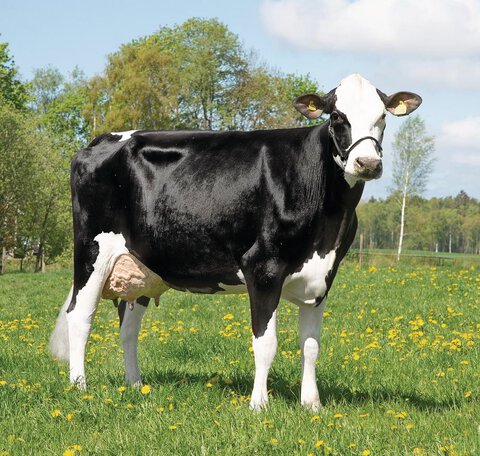
In the picture: ProCROSS cow daughter of VH Neptune, from Anders Nilsson's herd Skråmered in Sweden.

Discover ProCROSS
ProCROSS cow daughter of VH Neptune
+9% Daily Profit with ProCROSS cows compared with Holsteins Discover ProCROSS
ProCROSS cows

Sign up for our Innovative Breeding newsletter

Find out how much annual extra profit you could make by switching from Holstein to ProCROSS! Calculate now
ProCROSS cows